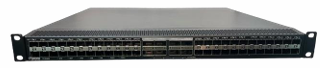
Meets Next-Generation 25G-100G Networking Requirements
TR-S5856 series data center TOR switch meets high-performance, high-density, low-latency 10G/25G data center access requirements, provides high-performance 100G uplink ports, and supports up to 48 25G access and 8 100G uplink ports for data center network. It meets the demand for high-speed interconnection in data centers, eliminates bandwidth bottlenecks, and meets the demand for network upgrades in the next 3~5 years.
Supports RoCE and build send-to-end zero-jitter delay network
TR-S5856 series data center TOR switch supports lossless Ethernet DCB (Data Center Bridging) technology, which solves the problem of traditional Ethernet congestion and packet loss, and provides a lossless network environment with zero packet loss, low latency, and high throughput to meet the RoCEv2 high- performance application requirements. RoCEv2 high-performance applications.
Based on ECN, which is a congestion control technology, the total amount of data entering the network is controlledthroughETStwo-levelschedulingtoavoidnetworkcongestion.TogetherwithRoCEnetworkcard to support end-to-end RoCE, it improves data transmission throughput, reduces network delay, lowers CPU load, and builds an end-to-end lossless Ethernet network with zero jitter delay, which is able to meet the requirements of data centers for the deployment of cloud computing, big data, AI, supercomputing, and so on.
Rich Data Center Features
TR-S5856 series supports ZTP protocol, it can automatically upgrade the version from the file server and automatically load the configuration file, so that the device can realize automatic opening, reduce manpower and improve deployment efficiency. Support hot patch upgrade and stacking support ISSU upgrade, fully data center on the need for highly reliable equipment.
TR-S5856 series supports cross-equipment link aggregation MLAG, realize inter-device link aggregation, provide rich networking model, support VLAN/VXLAN dual-quadrant access, MLAG equipment can realize uninterrupted service upgrades, and the upgrade process is not perceived by the user. MAC-in-UDP technology is adopted to encapsulate the data messages sent by VMs in UDP messages, which are transmitted in the underlay network, and then decapsulate VXLAN after reaching the destination VTEP to forward the inner layer data to VMs, which can effectively solve the problems of large Layer 2 network of dual-active data centers as well as the migration of VMs across geographical regions